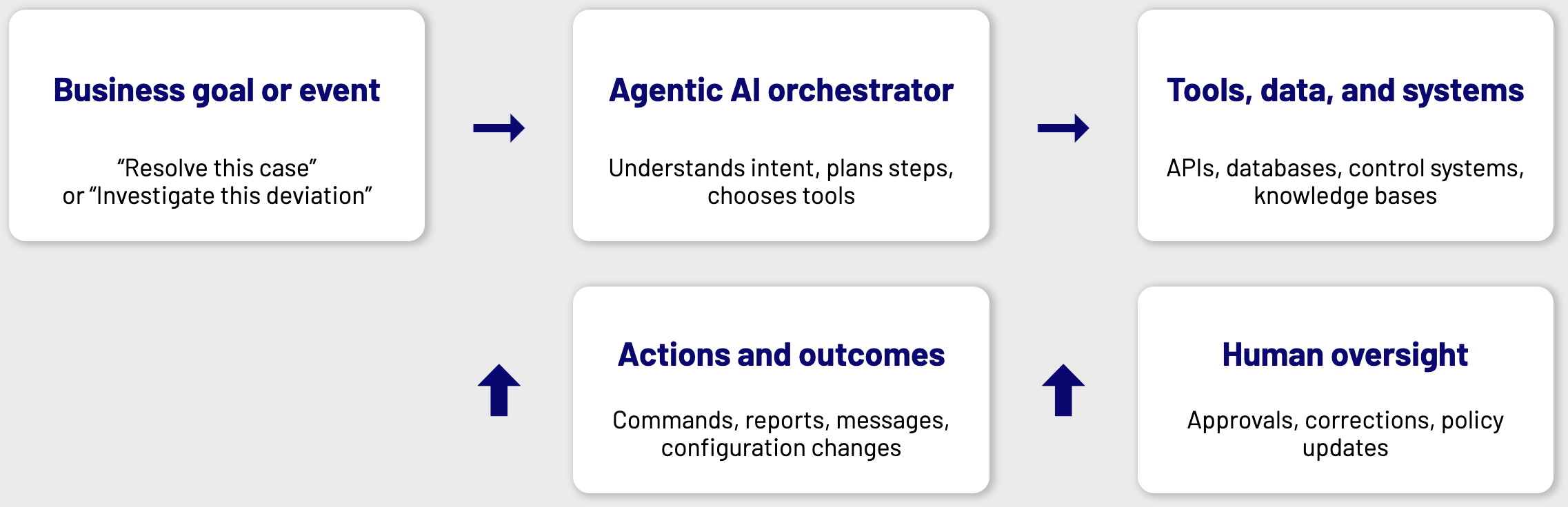
Business goal or event
“Resolve this case”
or “Investigate this deviation”
Agentic AI orchestrator
Understands intent, plans steps, chooses tools
Tools, data, and systems
APIs, databases, control systems, knowledge bases
Actions and outcomes
Commands, reports, messages, configuration changes
Human oversight
Approvals, corrections, policy updates
1. Understand the goal or trigger: The agent reads a human request or a system event, interprets the intent, and translates it into a clear internal objective, such as resolving a specific alarm or restoring performance.
2. Plan a sequence of steps: Based on predefined policies and its knowledge, the agent decomposes the objective into actions such as gathering data, checking rules, running diagnostics, or preparing a recommendation.
3. Call tools and systems: The agent uses connectors (APIs, RPA, integrations, control system interfaces) to query databases, read telemetry, call external services, update records, or execute predefined commands. Each step is logged.
4. Evaluate and iterate: The agent checks whether the intermediate result satisfies the goal and applicable constraints. If not, it adjusts its plan, explores alternative hypotheses, or requests additional diagnostics.
5. Involve humans when needed: For sensitive actions or ambiguous cases, the agent requests approval, presents options, and incorporates feedback into its next decisions. If a problem cannot be safely resolved, it hands over the case with a clear explanation instead of guessing.