Germany’s industrial data asset: why data alone does not create an AI advantage
A sales engineer has to submit a quote for a custom solution by Friday. Whether the variant is feasible is written somewhere in the documentation of an earlier project, in Jira tickets for a similar order, or in a specification in the repository. He asks three colleagues and waits for answers. The customer waits with him, and the quote goes out later than it had to.
Many companies know cases like this. The knowledge is there, but it is spread across systems and people. Every follow-up question ties up experts who are needed elsewhere. Every day of delay can cost the order.
What if the sales engineer had the answer straight away, with a reference to the ticket and the specification? That is what SenseDrive — The industrial knowledge platform for source-verified answers, on your own IT infrastructure — is built for. It is developed at SABO IT. The platform draws on connected sources such as Confluence, Jira, SharePoint, Git or your own document management system, and cites a source for every answer. Whether it pays off for you depends on your data.
Germany has decades of industrial know-how and large volumes of data. Yet much of it is hard to reach, poorly connected or barely used. Current figures show the gap: 57 percent of companies use AI, but only 22 percent use it in production. 60 percent barely tap the potential of their data.
Anyone who wants to use AI economically has to make existing data usable in the right context.
A data asset only becomes an asset once someone can lift it. We show you why there is a gap between holding data and holding a competitive advantage, and how to measure that gap in your own operation. The same question is at the center of the Stuttgart Knowledge Management Days (WiMa-Tage) on 25 and 26 November 2026: how is knowledge prepared so that AI can work with it in everyday work?
Is a large volume of data already a competitive advantage?
“Germany is sitting on a huge industrial data asset”, says the federal government. That is a real opportunity. Factories, machines and engineering departments produce data on production processes, quality checks, maintenance and design. On top of that comes the experience of the people who work there. Both can help to improve processes and to develop new products and services.
But a large volume of data is not yet a usable data asset. Data has to be findable, understandable, current and suitable for a specific purpose. It has to be possible to bring it together with knowledge from other systems without breaching access rights, data protection and trade secrets.
Where does AI actually arrive in the business?
Many German companies already use AI. According to an ifo survey, 54.5 percent of companies used AI in their business processes in May 2026; in industry the figure was 58.7 percent. A later Bitkom survey arrived at 57 percent in September. The results come from different surveys and are not directly comparable. Both show that more than half of companies now use AI.
Little of that reaches the shop floor. In the Bitkom survey, nine out of ten companies using AI saw themselves as still at the beginning when it comes to tapping its potential. Only 22 percent used AI in production processes. According to the same survey, the costs arise above all in infrastructure, data preparation and integration into existing systems.
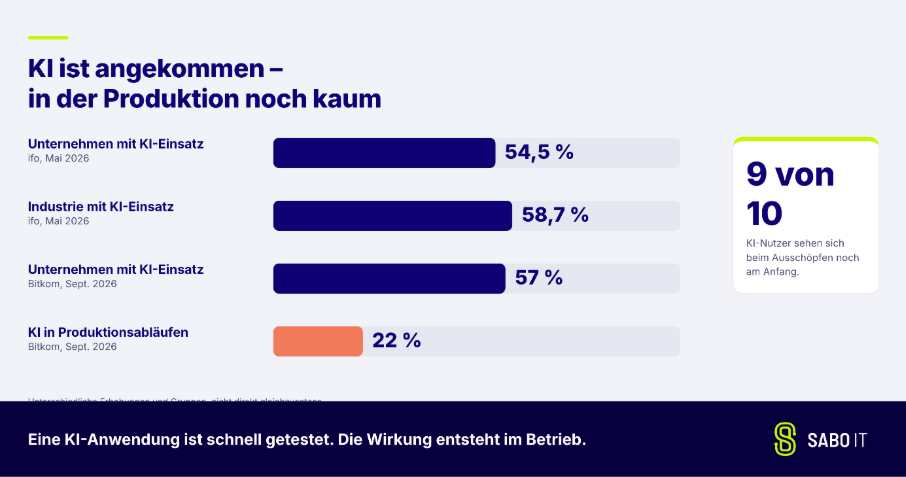
An AI application can often be tried out within days. Embedding it reliably into working processes takes suitable data, clear responsibilities and a technical foundation that fits. Little of that shows up in the price of the software. What gets expensive is the integration, and the rework after wrong answers.
Why are the right data missing, despite all the data?
Two further Bitkom surveys show how wide the gap is:
- 60 percent of the companies surveyed tapped the potential of their data little or not at all in 2025.
- 57 percent of industrial companies lack the data they need for digital twins in 2026.
- 48 percent see shortcomings in their IT infrastructure as an obstacle.
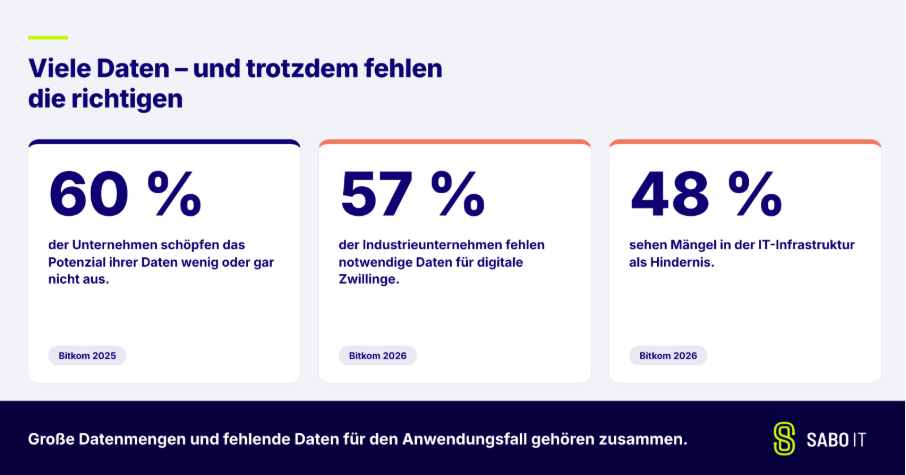
The surveys examine different questions and different groups. Together they show that a company can hold large volumes of data and still not have the data a given use case needs.
Existing data is not automatically usable. Information sits in different systems, uses different terms, or is hard to interpret without context. For the sales engineer, an old Jira ticket only helps once it can be matched to the right variant, the customer and the valid specification.
Data therefore usually becomes economically valuable only when someone connects it and puts it in order. Which information belongs to which product, case or process? Is it still current? Are there contradictory entries? And is the person who needs an answer allowed to access the underlying information?
Where does SenseDrive come in?
Industrial companies have to make existing knowledge quickly and reliably available in everyday work. Technical information is spread across documents, wikis, tickets, code repositories and other sources. When people spend a long time searching, or have to put the same questions to experienced colleagues again and again, part of that knowledge stays economically unused.
SenseDrive from SABO IT links the knowledge sources that are connected to it, such as Confluence, Jira, Git and files. Every answer points to its cited passage. Verified means: every answer is tied to traceable passages in your own documents. What is checked is whether the answer is supported by your sources, not whether your sources are right. Access rights are enforced at retrieval, and contradictions between sources are marked. If the information base is not sufficient, SenseDrive says so and gives no answer.
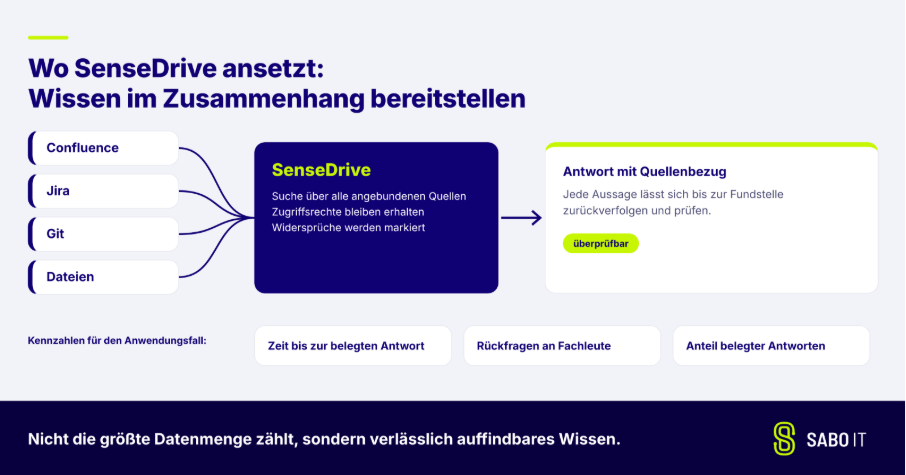
We will not calculate a saving for you out of somebody else’s study. A business case only holds up with your own figures. That is why we measure first on one concrete use case, for example the sales engineer’s quote:
- Time: how long does it take to find a technical answer or a documented solution?
- Follow-up questions: how often do experts have to be brought in to clarify something?
- Traceability: can the answers be checked against their sources?
That shows you whether knowledge that is easier to reach brings a measurable advantage. We record the baseline before we read in the first source. In the fixed-price pilot we measure the same figures again. The comparison gives you your business case and a clear go/no-go decision. If the business case does not hold, we tell you that too.
SenseDrive comes in one step earlier: it makes information from connected knowledge sources findable and traceable. Sensor data streams, real-time optimization and autonomous machine control are not part of it.
Two questions for you
An advantage only emerges once you open up data and knowledge for concrete tasks, connect them and build them into your working processes. Two questions help you get started:
Do you know how long it takes in your company until a technical question has an answer backed by a source?
And where is the knowledge you most often lack: in systems, or in the heads of individual experts?
Sources