Kurz gesagt: Ein Hersteller fand unseren Ansatz zu projektlastig und entschied sich für ein fertiges Werkzeug mit eingebautem Branchenwissen. Zwei Jahre später startete er einen Pilot mit uns. Die Vorlage kannte seine Maschinen nicht, und sie kannte nicht die Arbeitsweise des Unternehmens. Die Lehre daraus: Wissen für den Service muss an die Prozesse des Kunden angepasst werden, nicht umgekehrt.
“Unfinished”
Two years ago, we showed SenseDrive to a manufacturer. I will not name the company. Their word for it was: unfinished.
What they meant was not missing features. They meant the way we work. We do not install SenseDrive and leave. We adapt it to the customer’s processes and knowledge, and that takes a project. They wanted a solution right now.
I understand that. When your service team is under pressure, ‘first we analyze your documents’ sounds like the opposite of help. As a product manager I nodded, but then I went home and my heart was broken.
The box with one truth
So they did the sensible thing and tried a ready-made solution, one built on industry knowledge: typical machines, typical faults, a shared vocabulary. On the first day it looks finished. That is its strength. A big one.
Then it met the real plant. Two things did not fit.
- It did not follow the company’s own proven procedures. Industry knowledge describes how things are usually done. A company has its own way, tested over years, and a service technician follows that one.
- It assumed one truth. The customer runs machines of different makes and ages. For the same fault there are several correct answers, depending on the machine in front of you. A template has one.
Industry knowledge does not know your machine. In this case it did not even know the fleet.
Full circle
And then they were back. As we are a German company, my boss welcomed the customer with a German saying: Man trifft sich immer zweimal (in English: one always meets twice).
I will be honest: I enjoyed that call. Yes, I did. But what I take from it matters more than the satisfaction. They did not return because we changed our mind about projects. They came back because they had seen what the alternative costs.
What ‘adapting’ means in practice
We did not ask the customer to adapt to SenseDrive. We adapted the work to their situation:
- The knowledge comes from their documents, tickets and rules, from every make and age of machine in the fleet.
- Where documents disagree, SenseDrive shows both statements and marks the newer source. There is no single truth to pretend about.
- Every answer carries its source passage: answers with source passage, not with gut feeling. If the sources do not cover the question, SenseDrive says so and gives no answer.
- Access rights come from the source systems. It runs on the customer’s own IT infrastructure, also offline. The language model is a setting you choose.
- We do not make you choose between on-premises and cloud. Some departments and use cases are better served on your own infrastructure, others in the cloud, so we set it up as a hybrid that fits each case.
The industry’s own expectation shows why this matters: 41 % of mechanical engineering companies expect to lose specialist knowledge when older staff leave, against 23 % across the whole economy (DIHK, December 2025; expectations, not losses that occurred). That knowledge is written down in different places, in different forms, for different machines. A template cannot collect it. A project can.
What I would do differently
Here is my product manager’s confession. It is a pity that we could not explain this better and faster. The customer had to find it out by trying a ready-made solution first. Many companies do. I would rather they did not have to.
And I do not want ‘project’ to sound like ‘wait’. So we start small: a pilot on a defined set of your documents, with a measured result at the end. If it works, we agree a contract. If it does not, you have lost a pilot, not a year.
And just to be clear, yes, a box is finished on the day you buy it. A project ends with a solution you can extend, and with a partner for the decades ahead.
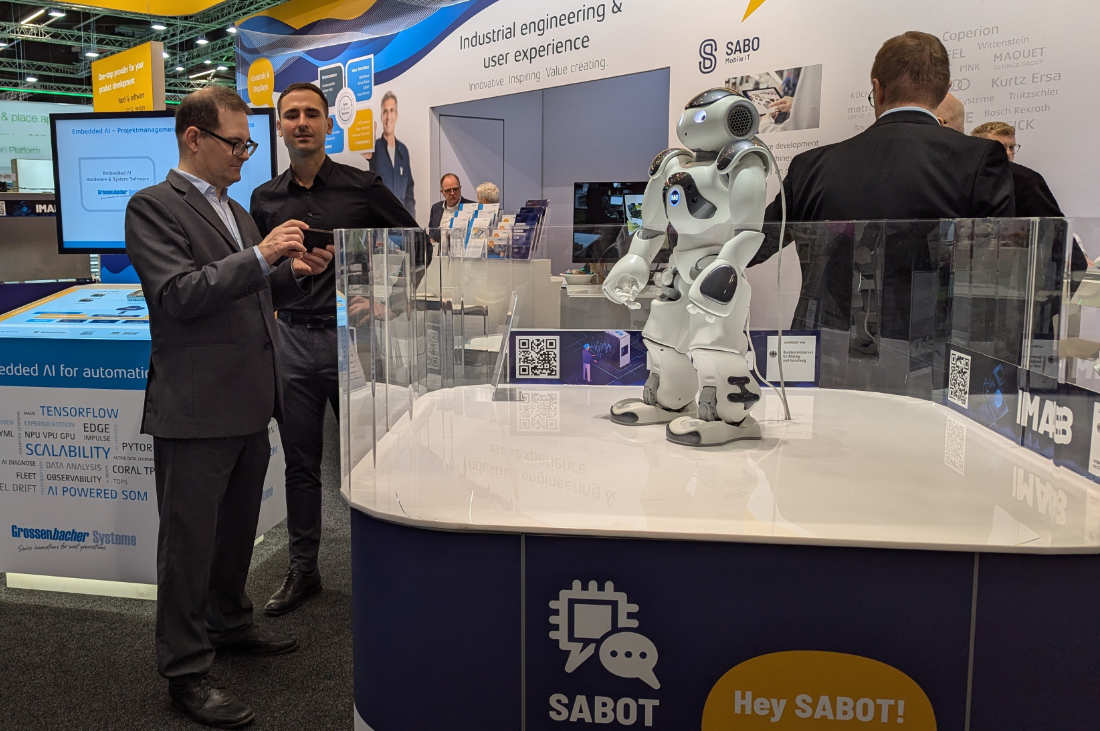
Bring one set of documents, a few machines of different makes and three real service questions. You can find us at SPS in Nuremberg and at the WiMa-Tage in Stuttgart, or write to us for a pilot discussion.
We cannot promise blanket figures, as your company is different from your neighbor’s. We measure the actual effect in the pilot. The actual effect FOR YOU. AI governance is part of the platform: sources, rights and traceability are built in.
SenseDrive — The industrial knowledge platform for source-verified answers, on your own IT infrastructure.