What does AI in the enterprise really cost? Why the price per user is the wrong number
29/10/2026
Guido Stanovski
Three reports from this year show why compute power is becoming a strategic question for European companies. According to Siemens board member Cedrik Neike, European data centers run 20 to 30 percent above US levels in operating costs, while companies, in his estimate, would pay only 5 to 10 percent more for it.
At the same time, top-tier US AI is getting cheaper. In September, Anthropic cut the token price of Claude Opus 5.5 by 20 percent against its predecessor. The sovereign European alternative remains expensive, because Europe is struggling with high electricity prices and tight grids, according to the EU Institute for Security Studies. If sovereign compute costs up to 30 percent more, can that premium be saved somewhere else?
The license fee is usually the smallest problem. What gets expensive is compute, integration, operations and above all wrong answers. We show you how to calculate the true cost of enterprise AI and how SenseDrive keeps it low from the start.
In the budget meeting everything looks manageable: an AI assistant for a few dozen euros per user per month. That fits into any department budget.
Six months later the bill looks different. Cloud costs rise with every query. IT builds interfaces nobody planned for. And in service, an experienced colleague checks every AI answer by hand again, because nobody wants to rely on it.
On top of that comes a development many companies in Europe are only now noticing: anyone who does not want to put their data into a US cloud pays more. The willingness to do so is greater than Neike assumes. In KPMG's Cloud Monitor 2026, 49 percent of the companies surveyed in Germany accept a premium of up to 20 percent for sovereign offerings, and a further 20 percent accept up to 30 percent. Only one company in five would therefore carry the full premium of up to 30 percent.
The gap cannot be negotiated away. It can be narrowed, if you do the arithmetic in the right place.
Where do the costs really arise?
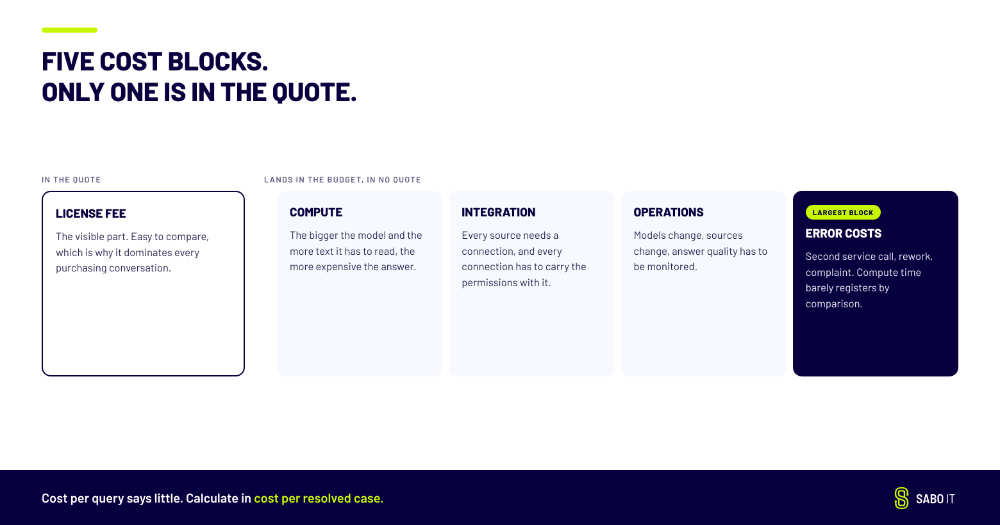
Anyone who looks only at the price per user sees one of five cost blocks. The other four appear in no quote, but they land in the budget:
License fee: the visible part. Easy to compare, which is why it dominates every purchasing conversation.
Compute: every query consumes compute time, in the provider's cloud or on your own hardware. The bigger the model and the more text it has to read, the more expensive the answer.
Integration: your knowledge sits in manuals, ticket systems, wikis and fault catalogs. Every source needs a connection, and every connection has to carry the permissions with it.
Operations: models change, sources change, answer quality has to be monitored. This is not a one-time task.
Error costs: the largest and most invisible block. A wrong answer costs the second service call, the rework, the complaint. Compute time barely registers by comparison.
Cost per query or per token therefore says little. A cheap answer that is wrong ends up costing you more than an expensive one that is right.
The right metric is cost per resolved case: per service question answered, per complaint closed, per quote completed. Hardly any company asks its AI vendors for this number. Ask for it anyway.
Where do the costs hide in the common solutions?
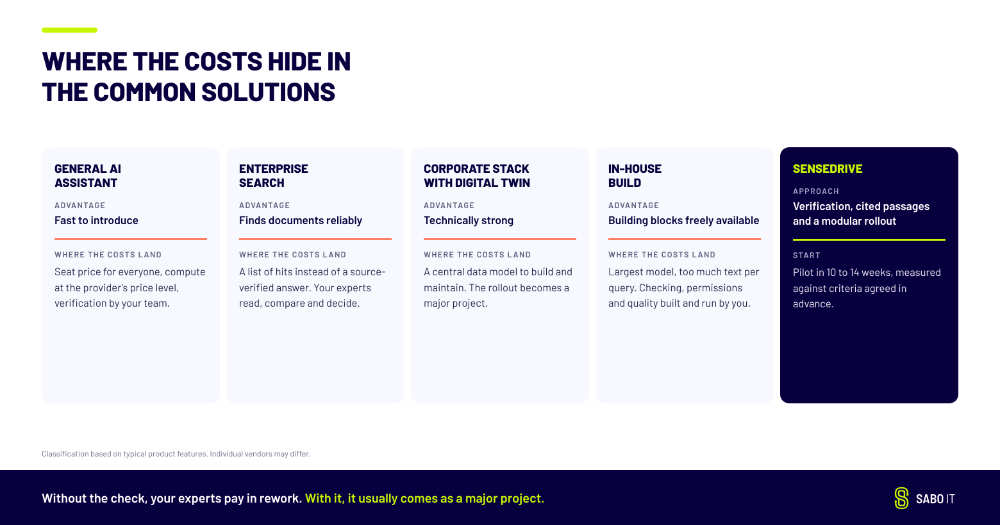
In the market, SenseDrive faces four typical alternatives. Each has an advantage. And each shifts costs to a place that does not appear in the quote.
The general AI assistant is quick to introduce and is paid per seat, for every employee, whether they use it daily or once a month. It supports its statements only in part, checks no contradictions and does not know your equipment knowledge. Questions about a service manual therefore often come back incomplete, and more often still when the assistant reaches the manual only through a connected file share. Running it yourself, including the language model, is rarely possible. The compute therefore runs in the provider's cloud, at the provider's price level. The cost of checking the result is carried by your team.
Enterprise search finds documents reliably, but it delivers a list of hits instead of a source-verified answer. Reading, comparing and deciding which source applies is left to the employee. Whether two sources contradict each other is not checked. So the costs land exactly with the experienced colleagues you wanted to relieve.
The corporate stack with a digital twin can do a great deal: source references, equipment knowledge, your own operation including the language model. It detects contradictions through a central data model. But that data model first has to be built and then maintained permanently. The rollout becomes a major project, and the costs move into integration and operations.
The in-house build looks cheapest, because the building blocks are freely available. The typical mistakes arise in operation. Every query goes to the largest available model, and the model is given more text than necessary. Both drive up compute costs. Contradiction detection, permission logic and quality monitoring have to be developed by your team first and then run permanently.
The common pattern: without the check, your experts pay in rework. With the check, it arrives as a major project or has to be built in-house. SenseDrive combines checking, cited passages and a modular rollout with a pilot of 10 to 14 weeks. Which solution is genuinely cheaper is still often unknown, because the invisible costs are not measured. This classification is based on typical product features; individual vendors may differ.
Why does a successful rollout become a cost risk?
A look at the knowledge base solutions on the market for industrial processes confirms the pattern. Some bill strictly per user per month and offer cloud operation only. Others charge a monthly flat fee for knowledge access, which makes the actual price per user hard to trace. What integration, operations and errors cost in the end usually stays open.
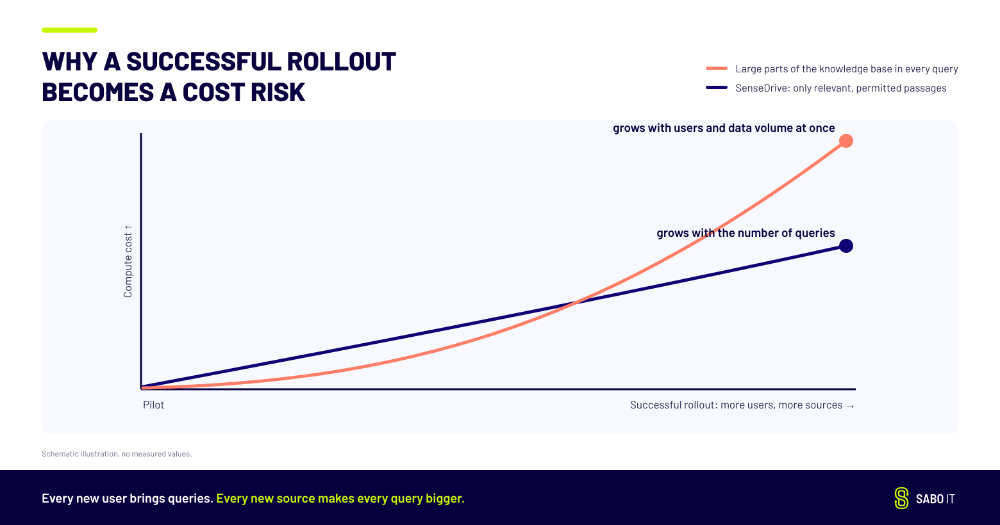
The real cost risk sits deeper, in the architecture itself. Many of these solutions pass large parts of the knowledge base to the language model with every query. At the start this barely shows. It becomes a problem as soon as a project runs successfully. Every new user brings additional queries, and every new source enlarges the data volume each of those queries works with. The compute costs therefore grow with both at once. The successful rollout becomes the most expensive scenario.
How does SenseDrive handle the costs?
SenseDrive – Your own industrial knowledge platform for source-verified answers, from the shop floor to the office.
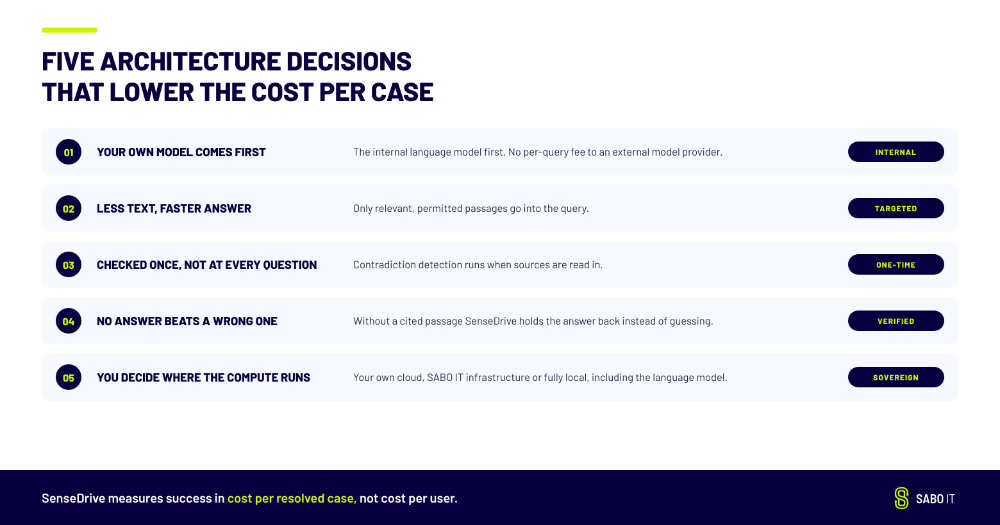
SenseDrive measures success in cost per resolved case. Behind that are five deliberate decisions in the architecture:
Your own model comes first. SenseDrive falls back first on the internal language model, an open model running in your SenseDrive environment. For this you pay no per-query fee to an external model provider. In your own operation your queries do not leave the house. Hosted models can be added by configuration, without new development. And if a cheaper model is good enough tomorrow, you swap it out.
Less text, faster answer. SenseDrive does not send your entire knowledge base into every query. Semantic search selects the relevant passages, and the permissions are enforced at retrieval from the index, not filtered afterwards. What a user is not allowed to see is never retrieved in the first place. Less text per query means less compute time per answer.
Checked once, not again at every question. Contradiction detection runs when the sources are read in. SenseDrive finds near-duplicates in the process and marks real contradictions permanently. The individual question therefore costs no additional check.
No answer is better than a wrong one. If there is no evidence in the sources, SenseDrive holds the answer back instead of guessing. Every answer is tied to a cited passage. That lowers the error costs, the largest cost block: the second call-out, the rework or the proofreading of every answer.
You decide where the compute runs. You set the place of operation and the model yourself, in your own cloud, in SABO IT's infrastructure or fully locally in your network, including the language model. Running it yourself is not automatically cheaper, because it needs compute capacity. But it makes your costs independent of the prices of any single cloud provider
Typical cost driver
How SenseDrive handles it
Every query goes to a large cloud model
The internal model always first, hosted models only as a supplement
Too much text in the prompt
Targeted retrieval of relevant, permitted passages
Checking effort on every query
Contradiction detection once, when sources are read in
Wrong answers and rework
An answer only with a cited passage, otherwise held back
Dependence on a single cloud price
You choose where it runs and which model
Nobody measures cost per result
Metrics and baseline fixed before the start
How do you find out what it costs you and what it brings?
We will not calculate a saving for you from somebody else's study, because a business case only holds if it rests on your own numbers.
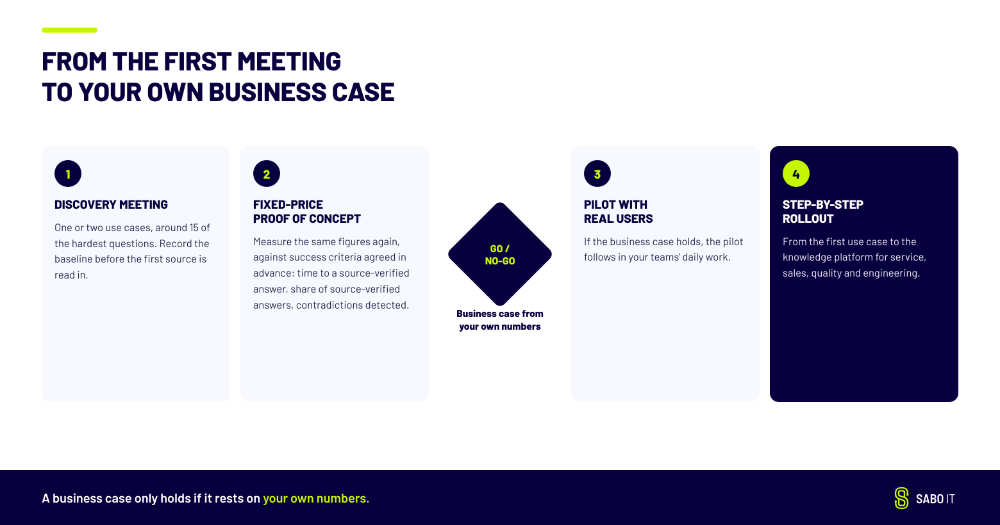
That is why SenseDrive starts with a measurement. In the discovery meeting we select one or two use cases with your specialist team and collect around fifteen of the hardest questions from your department, together with the relevant documents. Before we read in the first source, we record the baseline: how long does a source-verified answer take today? How often does somebody have to ask again?
In the fixed-price proof of concept that follows, we measure the same figures again, against success criteria agreed in advance: time to a source-verified answer, share of source-verified answers, contradictions detected. From the comparison come your business case and a clear go/no-go decision. And if it does not hold, we will tell you so. If it does, the pilot with real users follows, and the step-by-step expansion from the first use case to the knowledge platform for service, sales, quality and engineering.
Two questions for you
Do you know the cost per resolved case that your current AI solution causes, or only the price per user?
And which cost block would be the largest at your company: compute, integration or the rework after wrong answers?
See SenseDrive live:
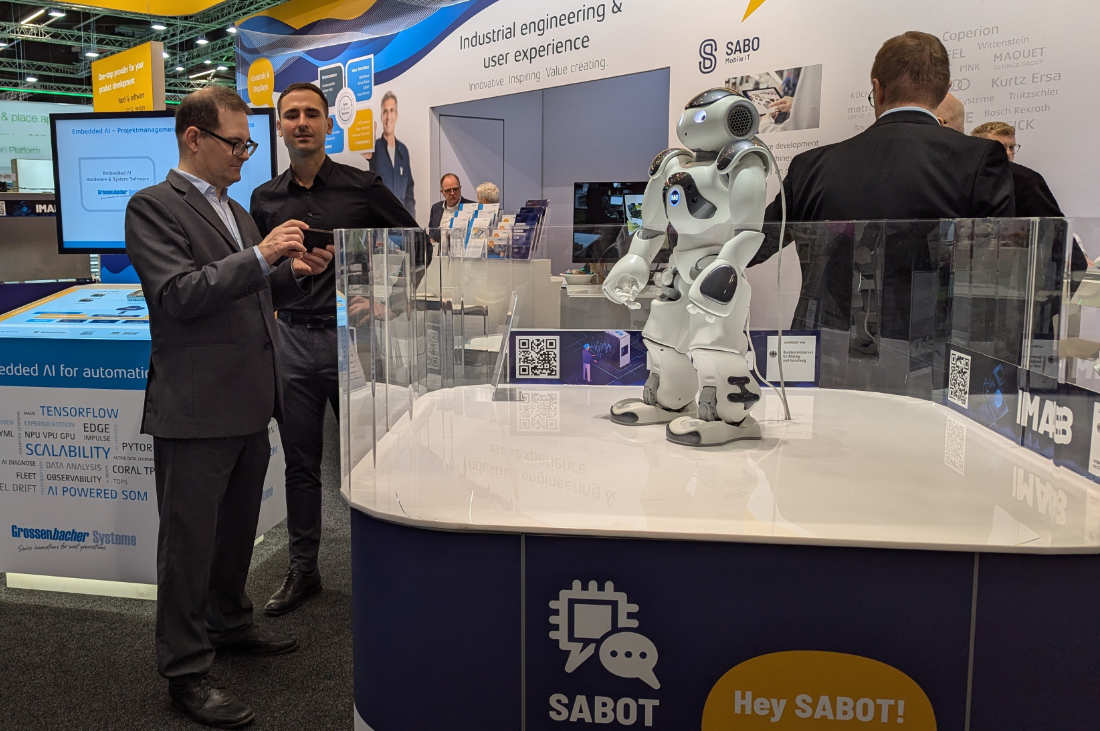
at SPS 2026 in Nuremberg, 24 to 26 November 2026, Hall 7, Booth 7-480,
and at the 22nd Stuttgart Knowledge Management Days (WiMa-Tage) on 25 and 26 November 2026 at the GENO-Haus in Stuttgart. In Stuttgart you will meet me in person. Bring your hardest technical question, and we will do the arithmetic together.
Sources
DIGITIMES: „Europe's AI infrastructure: the cost gap that policy cannot paper over“, 22.06.2026, with statements by Cedrik Neike (Siemens) at VivaTech 2026: https://www.digitimes.com/news/a20260622VL214/eu-europe-ai-computing-power-cost-2026-infrastructure.html
KPMG: Cloud Monitor 2026, survey of more than 500 companies in Germany: https://kpmg.com/de/de/themen/digital-transformation/cloud-transformation/cloud-monitor-2026.html
Anthropic: Claude Opus 5.5, price announcement of 22.09.2026, report at TechCrunch: https://techcrunch.com/2026/09/22/anthropic-releases-opus-5-5-with-lower-prices-and-fable-level-performance/
EU Institute for Security Studies: „Feeding the beast: Energy security as a precondition for the EU's AI power“, brief of 28.09.2026: https://www.iss.europa.eu/publications/briefs/feeding-beast-energy-security-precondition-eus-ai-power
Mesago: SPS 2026, dates and opening hours: https://sps.mesago.com/nuernberg/en/expo/planning-preparation/opening-hours.html
wissensmanagement – das Magazin: 22nd Stuttgart Knowledge Management Days, 25 and 26 November 2026, GENO-Haus Stuttgart: https://www.wissensmanagement.net/events/kongresse.html
Guido ist Business Development Manager bei SABO IT und arbeitet unter anderem an der Positionierung und Markteinführung von SenseDrive. Seine langjährige Erfahrung aus der Industrie setzt er ein, um technische Innovation und messbaren Kundennutzen zusammenzubringen.
SABO IT develops custom software for companies with complex technical processes, from the control unit through the cloud to enterprise systems, including in regulated environments. It also has its own platforms: SenseDrive for source-verified answers from your own knowledge base, and SABOT for voice control of machines. Software development since 1983, as SABO IT since 2012; the average customer relationship lasts 6.5 years.
Service knowledge: why can no one find the answer that already exists?
The answer almost always exists. No one trusts it because two sources disagree. SenseDrive from SABO IT, the industrial knowledge platform for source-verified answers, works differently from AI assistants and document chat tools.