We are paid to tell you things you do not want to hear
12/11/2026
Kryštof Bumbálek
It usually happens about an hour into our quarterly planning session at SABO IT. This is where the customer and the team agree on what will be delivered over the coming months.
The customer has presented their priorities. The team has broken them down into tasks and estimated the effort involved. Then the customer compares what the team can realistically deliver with their wish list — and the numbers do not add up.
The room falls silent. Everyone is waiting for someone to say it. Then someone speaks up: “This will not all fit into this quarter.” That someone is us, the project managers.
Nobody likes hearing that sentence. But we have learned that the things customers least want to hear are often the most valuable things we can say. Speaking uncomfortable truths is not a last resort for us. It is part of the job.
Why does a status report stay green until it turns red?
Anyone who has worked on a software project knows the watermelon: green on the outside, red on the inside. Every status report says “on track.” Every risk is “under control.” Then, two weeks before the deadline, everything is on fire.
This happens because bad news feels threatening. The service provider fears that admitting a problem could cost them the contract. The project manager hopes the team will still catch up. So the problem goes unspoken, week after week.
The customer pays the price. They lose exactly what they would have needed most: time to respond. By the time the truth comes out, only expensive options remain.
Three uncomfortable conversations we deliberately have on a regular basis
“This will not fit into this quarter. We need to reduce the scope.”
We say this every quarter. Customers bring more priorities to planning than a team can deliver. That is normal: their business does not revolve around our team’s capacity.
The easiest option would be to agree to everything and hope for the best. Instead, we show how much work the team can realistically take on and ask the customer to prioritize. The first few minutes are uncomfortable. Then it becomes the most useful conversation of the entire planning session. At the end of the quarter, the customer gets what we committed to, rather than half of what they had hoped for.
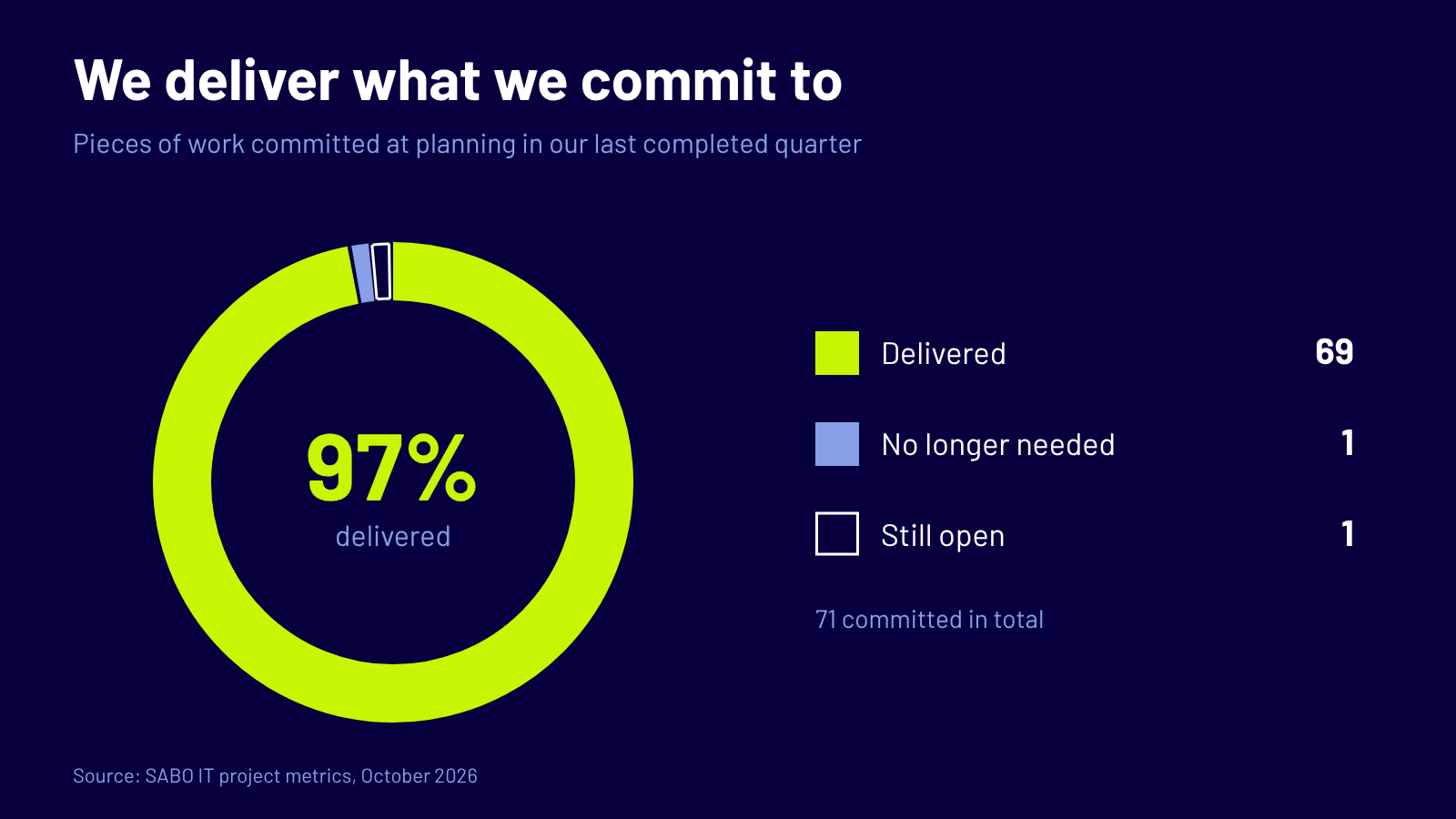
Our most recently completed quarter shows what this means in practice. We committed to 71 tasks and delivered 69. One task was no longer needed; another is still open. During the same quarter, 12 new requests came in. We addressed four immediately, including a security incident. The other eight had to wait, rather than being squeezed in at the expense of work we had already committed to.
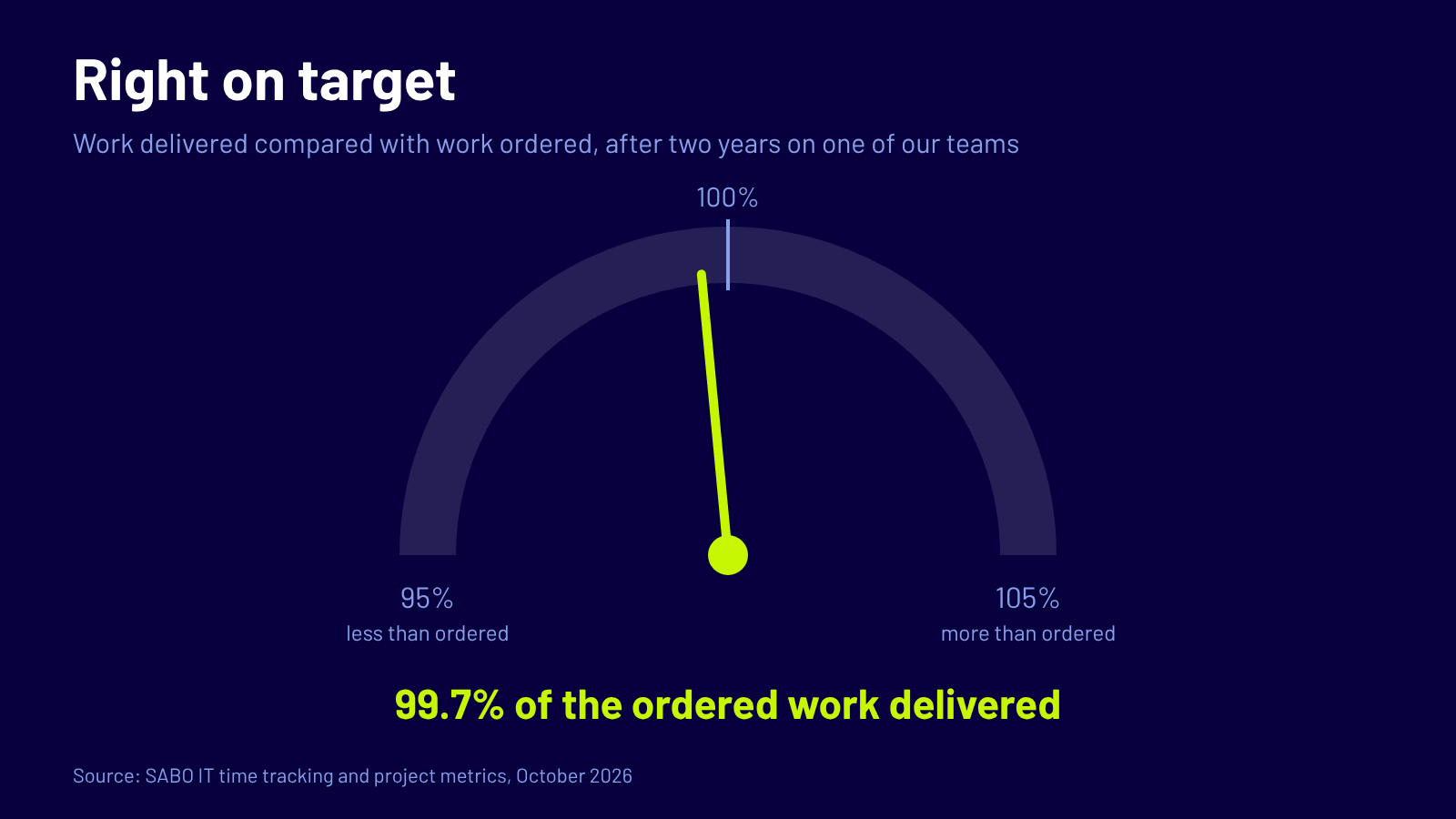
Speedometer chart comparing work delivered with work ordered over two years in one team. The needle points to 99.7% on a scale from 95% (less than ordered) to 105% (more than ordered).
“This task is not ready yet.”
A new task arrives with a one-line description, no clear definition of when it is “done,” and an urgent deadline. We could simply start and clarify the rest as we go. We know how that ends: two weeks of work, a first look at the result, and then the customer says, “That is not what we meant.”
So we say no — but only to starting without a clear goal. We sit down with the customer, agree on what “done” means, and schedule the task for the next two-week cycle. At first, this feels like a delay. In practice, it is the fastest route to the right result, and the least expensive, because we avoid dead ends.
“The budget will not cover this.”
Budgets rarely run out all at once. They shrink week by week until, one day, the numbers no longer add up. When we see it coming, we say so early: at the current rate, the remaining budget will not cover all the planned tasks.
This is an uncomfortable message, especially when the customer has to pass it on to their own management. If it comes months in advance, there are still options: reprioritize, extend, or cut back. If it comes late, it becomes a problem.
That is why we reconcile the budget with the work actually performed every two weeks, rather than just once a quarter. One of our teams has worked around 2,300 man-days over the past two years. The difference between what the customer ordered and what we delivered is seven man-days — approximately 0.3%.
Doughnut chart: of the 71 tasks committed to during planning for the last quarter, 69 were delivered, one was no longer needed, and one is still open. This means 97% of the tasks were completed.
What else do we raise?
We tell customers when adding people will not make the team faster because onboarding initially slows everyone down. We also tell them when a feature is not worth developing, even if it would mean billable work. And if we reduce the scope of testing to meet a deadline, the customer hears that from us too. The risk then becomes a conscious, shared decision rather than a surprise in production.
Honest without being harsh: how do you deliver bad news in a way that helps?
Saying uncomfortable things is easy. Saying them in a way that actually helps is the real skill. We follow three rules.
Tell them early. Bad news have a shelf life. The same message that gives a customer room to maneuver in week two can back them into a corner in week ten.
Bring the numbers. “I have a really bad feeling about this” sparks a debate. Facts open up a conversation about how much the team can deliver, how quickly it is actually delivering, and how much work remains. With the numbers on the table, the customer sees what we see.
Never bring just a problem. Every difficult message needs at least one way forward: reduce the scope, change the order, or identify a decision we need from the customer.
Why does bad news build trust?
This may sound contradictory at first. Customers trust us precisely because we tell them what they do not want to hear. Customers who know we raise problems also believe us when we say everything is on track. With us, a green status means green. That allows the customer to plan, make commitments to their own management, and avoid having to double-check our work.
Over time, the working relationship changes. A supplier who needs to be managed becomes a partner who works with the customer to find solutions. In our experience, this is how a single project becomes a long-term partnership.
One of our customer relationships shows how this works. It began several years ago, and two years ago we were working on a single project for this customer. Today, we manage six projects in parallel and deliver more than four times as much work as we did then.
Why is this not easy for us either?
We do not pretend this comes naturally. Nobody likes being the person whose words make the room fall silent. A quiet voice always says: wait another week; perhaps the team will catch up.
And sometimes we are wrong. A risk we flagged never materializes. Or the customer knows something about their priorities that we did not know. When that happens, we are just as open about it. Openness only works both ways.
What question should you ask your service provider?
If you work with an external team, think back over the past few months. Has your service provider ever told you something you did not want to hear? If not, it is worth asking what they have not told you.
And if you would prefer to hear it early, talk to us.
Kryštof Bumbálek is a Scrum Master at SABO IT. He leads several software delivery projects for the VW Group and is your first point of contact for agile project management at SABO IT, including honest answers about where a project really stands.
SABO IT develops custom software for companies with complex technical processes, from the control unit through the cloud to enterprise systems, including in regulated environments. It also has its own platforms: SenseDrive for source-verified answers from your own knowledge base, and SABOT for voice control of machines. Software development since 1983, as SABO IT since 2012; the average customer relationship lasts 6.5 years.
What does AI in the enterprise really cost? Why the price per user is the wrong number
Three reports from this year show why compute power is becoming a strategic question for European companies. According to Siemens board member Cedrik Neike, European data centers run 20 to 30 percent above US levels in operating costs, while companies, in his estimate, would pay only 5 to 10 percent more for it.