

In the previous post I explained why keyword search and BM25 are still important. They are strong when the query contains exact terms like error codes, part numbers, or machine names.
But exact matching is not enough when users and documents use different phrasing. That is exactly where vector search becomes useful – and that is one of the reasons why it has become so important in RAG systems.
Vector search works differently from keyword search. Instead of matching exact words, it tries to match meaning.
The system uses an embedding model to convert text into a vector.
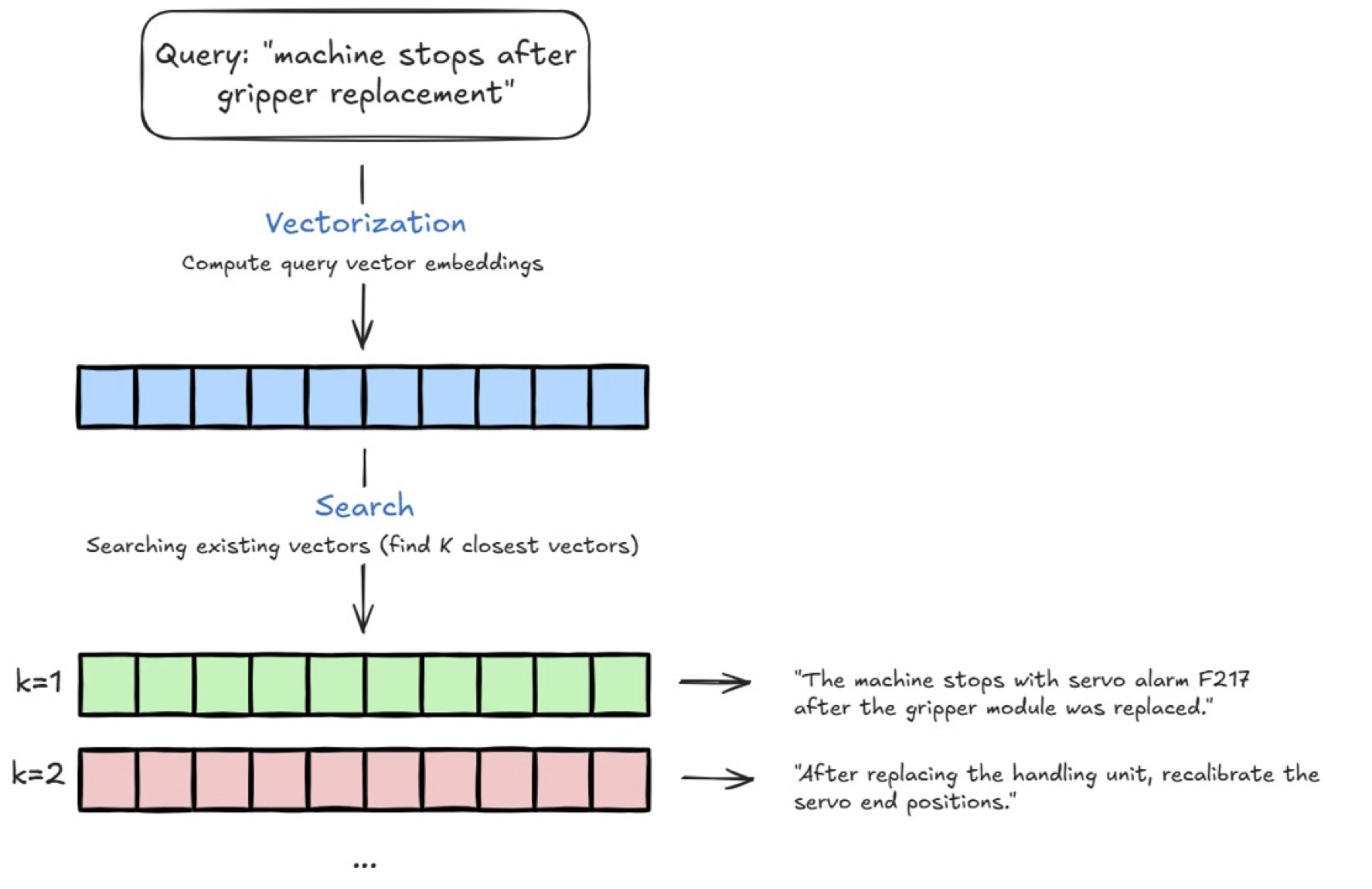
For example, the query:
query = "machine stops after gripper replacement" is converted into something like:
query_vector = [0.21, 0.54, 0.10, ...] Documents are also converted into vectors.
The system then compares the query vector with the document vectors and finds the most similar ones.
A common method for comparing vectors is cosine similarity. The idea is to measure the angle between two vectors. If two vectors point in a similar direction, the texts are considered semantically similar.

This allows the system to find documents that do not use the exact same words, but still talk about something similar.
For example, imagine these two documents:
Document 1:
The machine stops with servo alarm F217 after the gripper module was replaced.

Document 2:
After replacing the handling unit, recalibrate the servo end positions.
Keyword search might miss Document 2 if the query contains “gripper” but the document uses “handling unit”. Vector search might still find it because the meaning is similar.
That is very useful.
It helps when documents use synonyms, different terminology, abbreviations, or slightly different phrasing. In real-world enterprise knowledge bases, this happens all the time.
The same thing can be described differently in a service ticket, a manual, a meeting note, and a product specification. Vector search helps connect these pieces.
But it also has a weakness.
It can sometimes be too fuzzy. It understands similarity, but technical systems often require exactness.
Zum Beispiel:
F217
F271
F127
These look similar as text. They could all be understood as servo alarm codes. But they may describe completely different problems.
The same applies to:
machine variant A
machine variant B

software version 2.1
software version 2.2

part number 700-1842
part number 700-1843
In technical queries, small differences can completely change the answer.
That is why vector search alone is not sufficient. It is excellent for semantic recall. It finds related concepts and similar meanings. But it should not be the only retrieval method when exact identifiers matter.
The practical solution is not keyword search or vector search. The practical solution is usually both. That leads us to hybrid search.
In summary: Vector search is powerful because it can find meaning, not just words. It helps when the query says “gripper” but the document says “handling unit”. But this flexibility also carries a risk. In technical systems, similar does not always mean correct. In the next post, I will explain why vector search alone can fail in real-world RAG systems.


