

In the previous post I explained how vector search works and why embeddings are useful.
They help us find documents even when the phrasing differs. They can connect “gripper module” with “handling unit”. They can find semantically related information from manuals, tickets, reports, and internal documentation.
But vector search alone is not enough for reliable RAG. Especially not in technical domains. The reason is simple: meaning alone is sometimes not enough. Sometimes exactness matters more.
Imagine a user asks for:
F217 A vector search system might understand that this is an alarm code. It might retrieve documents about other alarm codes because they are semantically similar.
But a document about:
F271 could be completely wrong for the question.
The same problem occurs with part numbers:
700-1842
700-1843
Or with software versions:
2.1
2.2
Or with machine variants:
AX-340
AX-360
For a human reader, these differences are obvious. For a vector model, they may not always be strong enough. The model might focus on the surrounding meaning and treat the identifiers as related details. In many business and industrial systems, this can lead to incorrect answers.
A RAG system that retrieves the wrong alarm code, wrong part number, or wrong machine variant can generate a response that sounds correct but is based on incorrect evidence.
That is one of the biggest risks in RAG. The answer can be fluent, convincing, and still wrong. That is why keyword search is still important. Keyword search is strong when exact terms matter. Vector search is strong when meaning matters.
Instead of choosing one method, modern RAG systems therefore often combine both. This is called hybrid search.
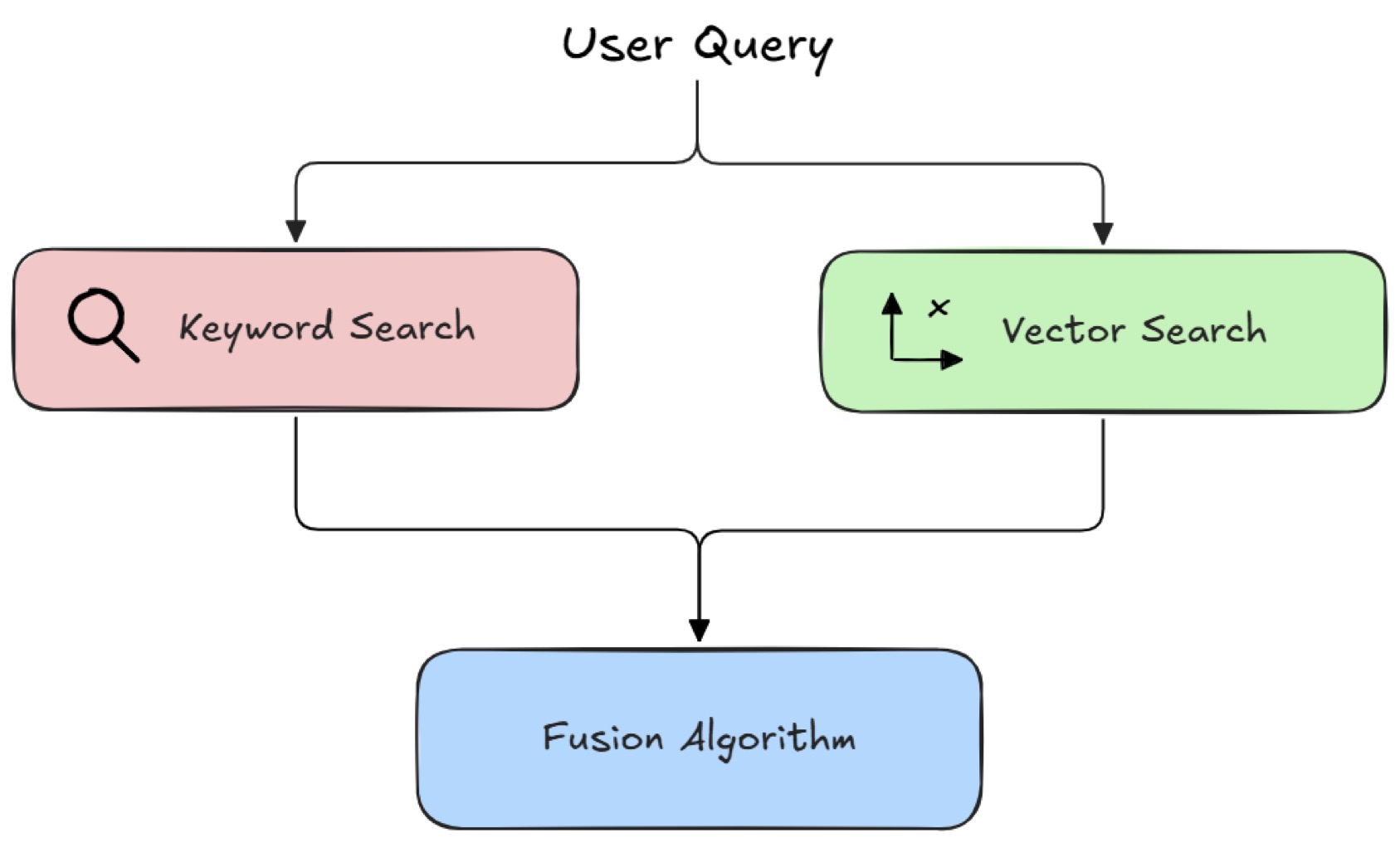
A hybrid search system can use BM25 or another keyword search method to find exact matches. At the same time, it can use vector search to find semantically similar documents.
This gives the system two different perspectives on the document collection.
Keyword search asks:
Which documents contain the exact terms?Vector search asks:
Which documents are semantically close to the query? Together they are stronger than either method on its own.
For a query like:
machine stops with servo alarm F217 after gripper replacementkeyword search helps retrieve the exact alarm code F217. Vector search helps find related documents that discuss replacing the handling unit, recalibrating servo positions, or checking the gripper axis. This combination improves both precision and recall.
But there is another problem. Keyword search and vector search return different rankings. Their scores are not directly comparable. BM25 scores and vector similarity scores operate on different scales. So we cannot simply merge the results and hope for the best.
We need a method to fuse the rankings. A simple and effective method is Reciprocal Rank Fusion.
In summary: Vector search is useful, but should not be the only retrieval method when exact identifiers matter. Keyword search provides precision. Vector search provides semantic recall.
The practical solution is usually to combine both. In the next post, I will explain hybrid search and show how Reciprocal Rank Fusion can merge keyword and vector results.


