Modern RAG, Part 4: Why Vector Search Alone Fails in Real Systems
28/7/2026
Richard Vlas
The fourth part of our series about modern Retrieval-Augmented Generation systems.
In the previous post I explained how vector search works and why embeddings are useful.
They help us find documents even when the phrasing differs. They can connect “gripper module” with “handling unit”. They can find semantically related information from manuals, tickets, reports, and internal documentation.
But vector search alone is not enough for reliable RAG. Especially not in technical domains. The reason is simple: meaning alone is sometimes not enough. Sometimes exactness matters more.
Imagine a user asks for:
A vector search system might understand that this is an alarm code. It might retrieve documents about other alarm codes because they are semantically similar.
But a document about:
could be completely wrong for the question.
The same problem occurs with part numbers:
Or with software versions:
Or with machine variants:
For a human reader, these differences are obvious. For a vector model, they may not always be strong enough. The model might focus on the surrounding meaning and treat the identifiers as related details. In many business and industrial systems, this can lead to incorrect answers.
A RAG system that retrieves the wrong alarm code, wrong part number, or wrong machine variant can generate a response that sounds correct but is based on incorrect evidence.
That is one of the biggest risks in RAG. The answer can be fluent, convincing, and still wrong. That is why keyword search is still important. Keyword search is strong when exact terms matter. Vector search is strong when meaning matters.
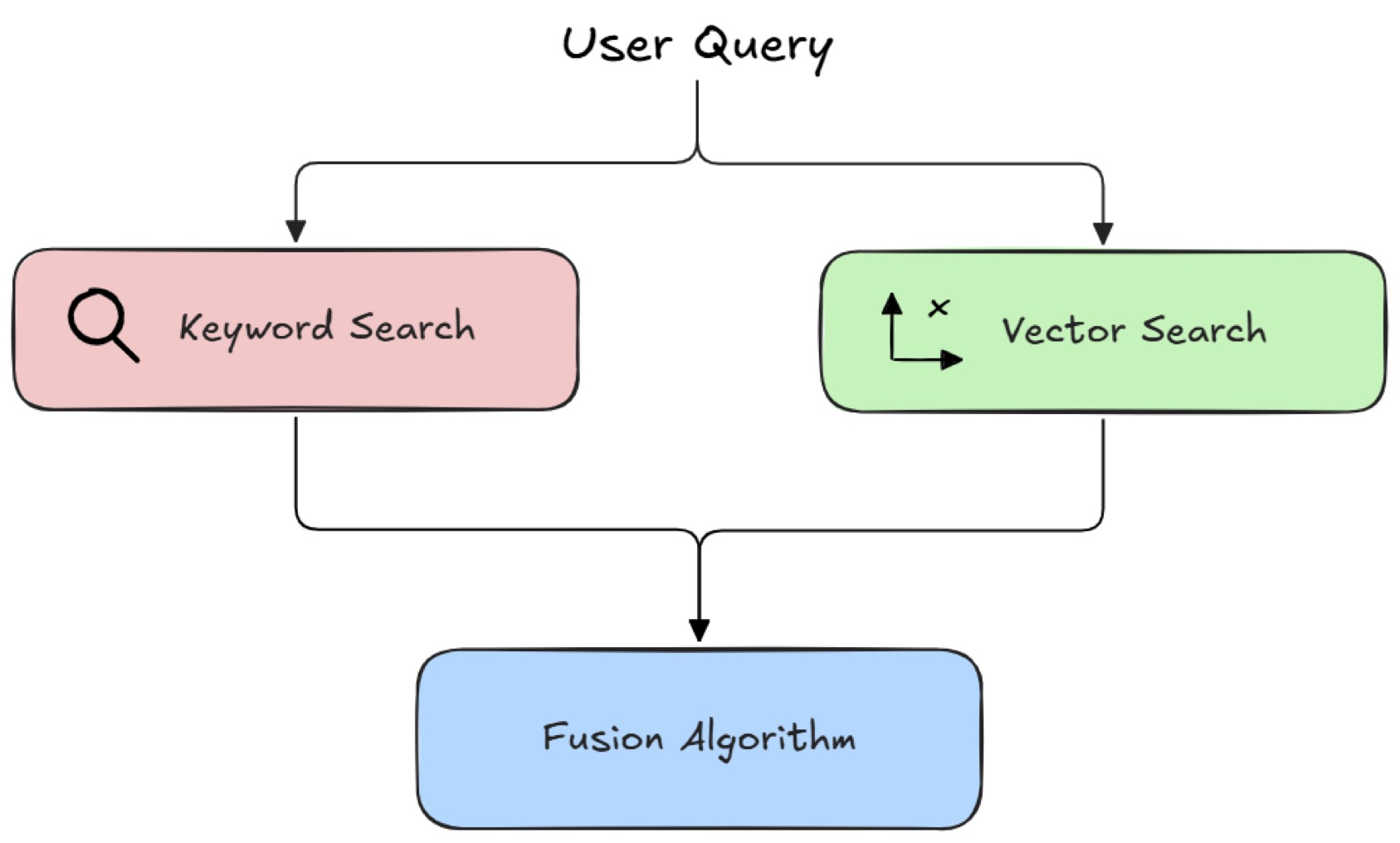
Instead of choosing one method, modern RAG systems therefore often combine both. This is called hybrid search.
A hybrid search system can use BM25 or another keyword search method to find exact matches. At the same time, it can use vector search to find semantically similar documents.
This gives the system two different perspectives on the document collection.
Keyword search asks:
Vector search asks:
Together they are stronger than either method on its own.
For a query like:
keyword search helps retrieve the exact alarm code F217. Vector search helps find related documents that discuss replacing the handling unit, recalibrating servo positions, or checking the gripper axis. This combination improves both precision and recall.
But there is another problem. Keyword search and vector search return different rankings. Their scores are not directly comparable. BM25 scores and vector similarity scores operate on different scales. So we cannot simply merge the results and hope for the best.
We need a method to fuse the rankings. A simple and effective method is Reciprocal Rank Fusion.
In summary: Vector search is useful, but should not be the only retrieval method when exact identifiers matter. Keyword search provides precision. Vector search provides semantic recall.
The practical solution is usually to combine both. In the next post, I will explain hybrid search and show how Reciprocal Rank Fusion can merge keyword and vector results.
Richard is a member of the SABO core team, where he combines deep technical expertise with a focus on clean design and best practices. As a Senior Machine Learning Engineer and Software Architect, he works on intelligent systems such as conversational assistants and AI-driven industrial solutions. His work bridges modern software architecture with real-world machine learning applications, often involving MLOps and scalable infrastructure. In his free time, he enjoys learning new languages and exploring how they shape the way we think and communicate.
SABO IT develops custom software for companies with complex technical processes, from the control unit through the cloud to enterprise systems, including in regulated environments. It also has its own platforms: SenseDrive for source-verified answers from your own knowledge base, and SABOT for voice control of machines. Software development since 1983, as SABO IT since 2012; the average customer relationship lasts 6.5 years.
What does AI in the enterprise really cost? Why the price per user is the wrong number
Three reports from this year show why compute power is becoming a strategic question for European companies. According to Siemens board member Cedrik Neike, European data centers run 20 to 30 percent above US levels in operating costs, while companies, in his estimate, would pay only 5 to 10 percent more for it.