
Never heard of Agentic AI? Check our previous post What to expect from Agentic AI?
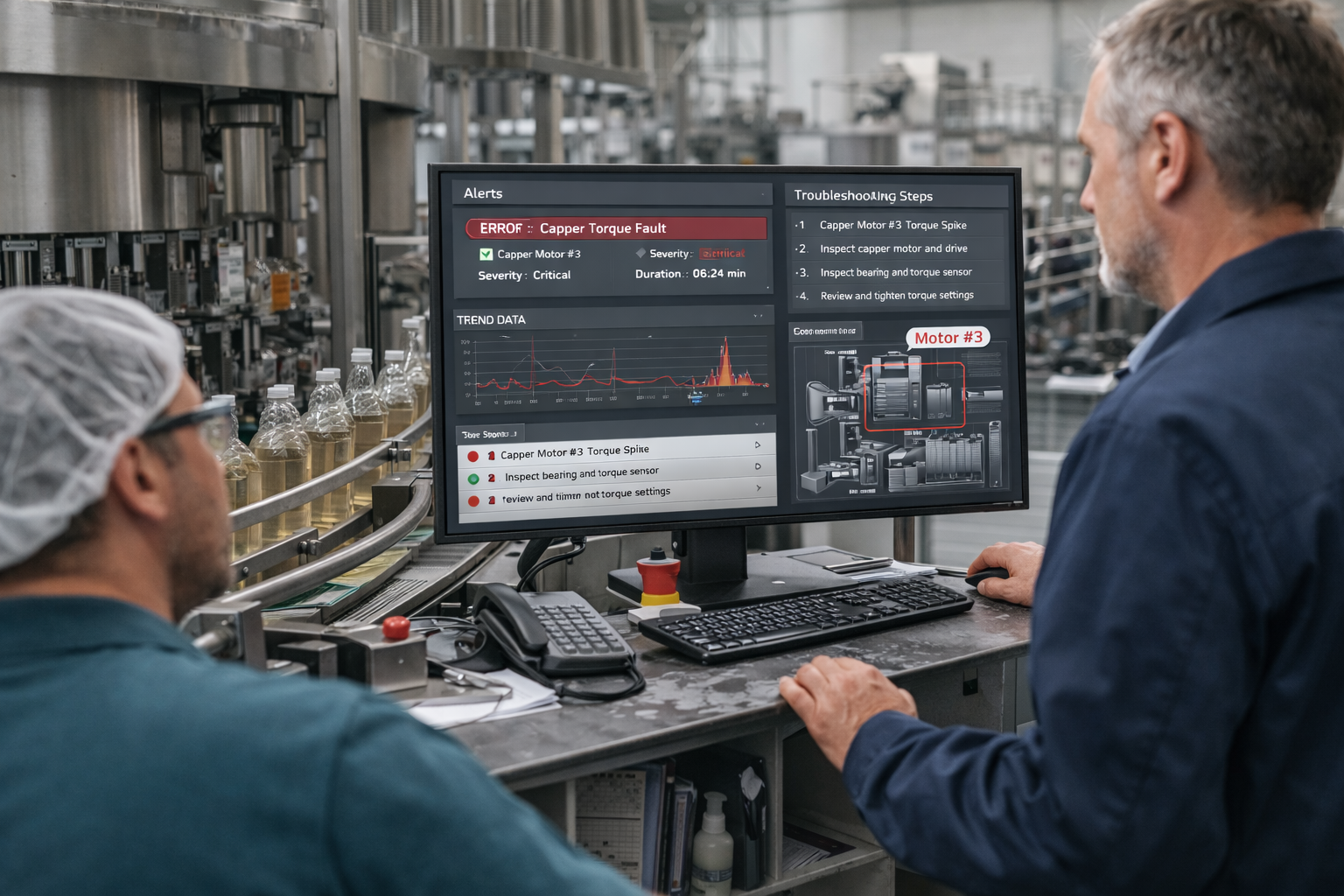
A bottling line is a demanding environment where even a small deviation can lead to reduced throughput, minor quality issues, or a complete stop. Operators and maintenance engineers often work under time pressure, switching between HMIs, manuals, and past experience to identify what changed and why. An agentic troubleshooting system reshapes this situation by acting as a persistent digital colleague that notices issues the moment they arise, interprets them in context, and prepares a structured path toward resolution. Instead of beginning with uncertainty, the team starts with clarity.
When an alarm, speed fluctuation, or quality deviation occurs, the agent immediately gathers telemetry, historical cases, and relevant documentation from the plant’s own sources. It presents a concise explanation of what is happening, which components are most likely involved, and which safe diagnostic steps have the highest probability of confirming the root cause. This does not replace expert judgement; it reduces the time experts spend digging for information and increases the time they can devote to decisions that matter. For a plant that runs tight schedules, these minutes accumulate into meaningful gains in stability and performance.
Once the likely cause is known, the agent recommends or executes predefined corrective actions. These actions are strictly limited to procedures approved by engineering, such as controlled resets, sensor checks, or parameter adjustments within safe ranges. The benefit for production managers is that the line returns to normal operation more quickly and with greater confidence that the underlying issue was properly addressed. The system documents what was done and why, creating a consistent record that improves cross-shift transparency and supports continuous improvement.
Over time, the agent builds a catalogue of resolved incidents and their outcomes, turning ad-hoc knowledge into an accessible asset. For machine builders and industrial-IT specialists working with small but highly specialised German manufacturers, this creates an opportunity to offer a more stable, predictable, and serviceable production environment without redesigning the machines themselves. The bottle line example illustrates a broader principle: an agentic AI system enhances the value of existing equipment by orchestrating information, decisions, and approved actions in a way that reduces downtime and increases trust in operations.
Ready to start talking about your case? Get in touch.


